Pixels, Proof, Profit.
Target’s Experiment-led Revenue Growth.
In a high-stakes retail environment, I designed tests that moved the needle.
My role? Finding, designing, and validating UX changes that boosted real revenue.
My role
As a Growth & Product Design Consultant at Target Retail Australia, I was embedded within core product teams to lead data-driven design experiments that directly influenced revenue-critical journeys.
My role was to identify high-impact opportunities, test relentlessly, and optimize for maximum ROI per pixel.
My Approach: Lean, Fast, and Business-Centric
We embraced a core philosophy: Lean UX. This meant building only what we needed to test, moving fast, and validating early. Failure wasn't a setback; it was feedback that propelled us forward. Every experiment was designed with clear business goals, ensuring direct alignment with our revenue objectives.
Lean UX: build only what you need to test.
Move fast, validate early: failure is feedback.
Wear the PM hat: prioritize business goals too
At scale, every pixel is profit.
When you're serving over 12 million users and generating billions in revenue, even a 1% uplift isn't a minor win-it's millions saved or earned. 💸
EXPERIMENT ONE
Could a few user‑generated content photos/videos boost trust, clicks, and revenue?
Customers doubt perfection. By showcasing real user photos instead of studio shots, we grounded expectations—and trust soared.
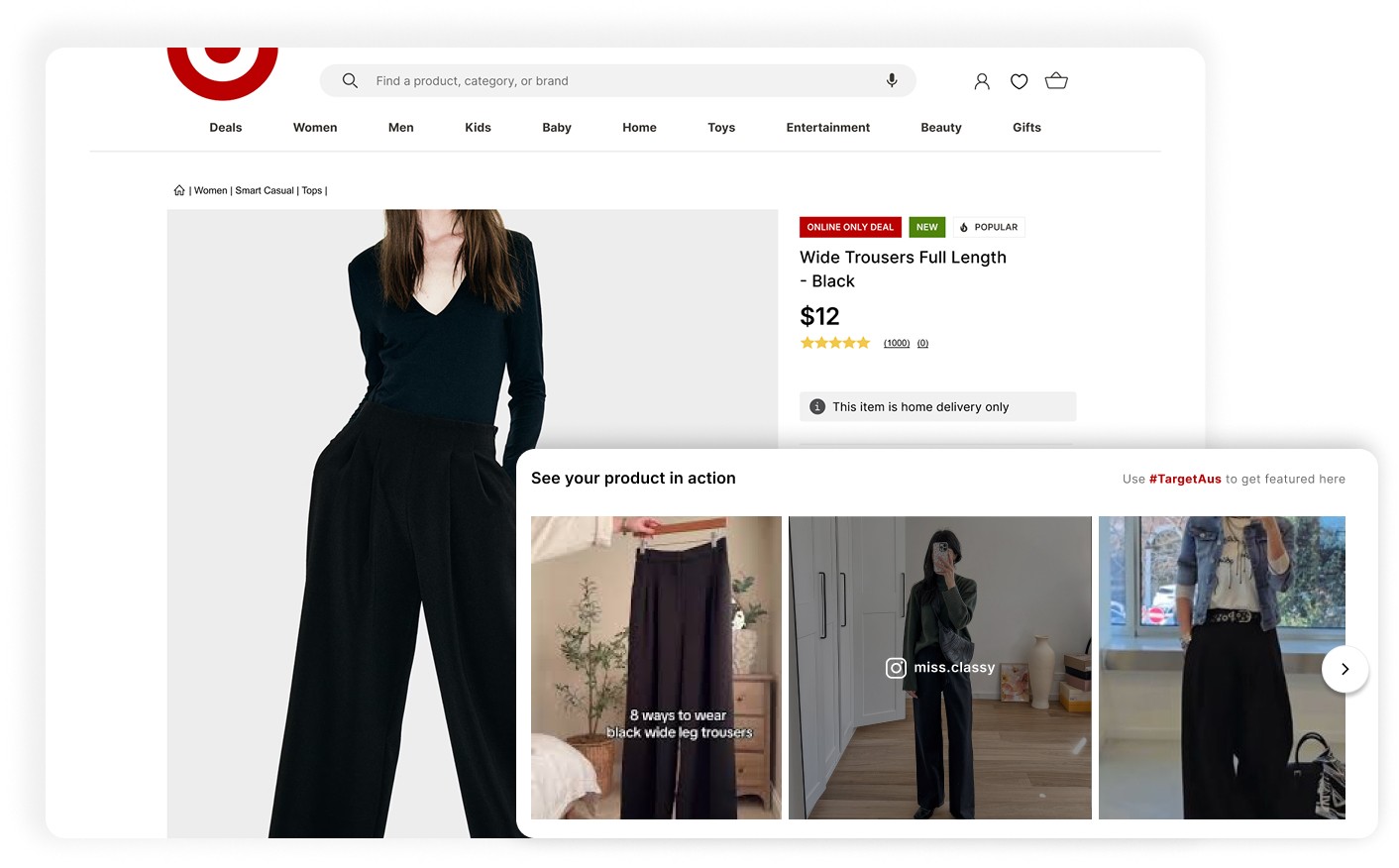
One of our primary hypotheses centered on User Generated Content (UGC). We knew customers often doubt perfection; studio-shot photos, while polished, lacked authenticity. By showcasing real user photos on Product Display Pages (PDPs), we aimed to ground expectations, build trust, and overcome purchasing hesitation.
TL; DR 💡
We wanted to include Instagram/Twitter posts related to the product in the display page to gain more user trust.
But early on, we hit an API roadblock that enables this.
But a strict 'lean UX' mindset forced me prove value with static photos without the API.
That decision led directly to our +3.2 % uplift in revenue.
The Challenge: Authenticity Meets Unexpected Technical Hurdles
We recognized that while polished studio shots conveyed product quality, they often lacked the authenticity that builds genuine user trust. Our hypothesis was simple: Could integrating User Generated Content (UGC) directly onto Product Display Pages (PDPs) create a stronger sense of relatability, overcome purchase hesitation, and directly impact conversion rates?
API roadblock that presented a significant technical hurdle, threatening to delay our experiment and impact our timelines.
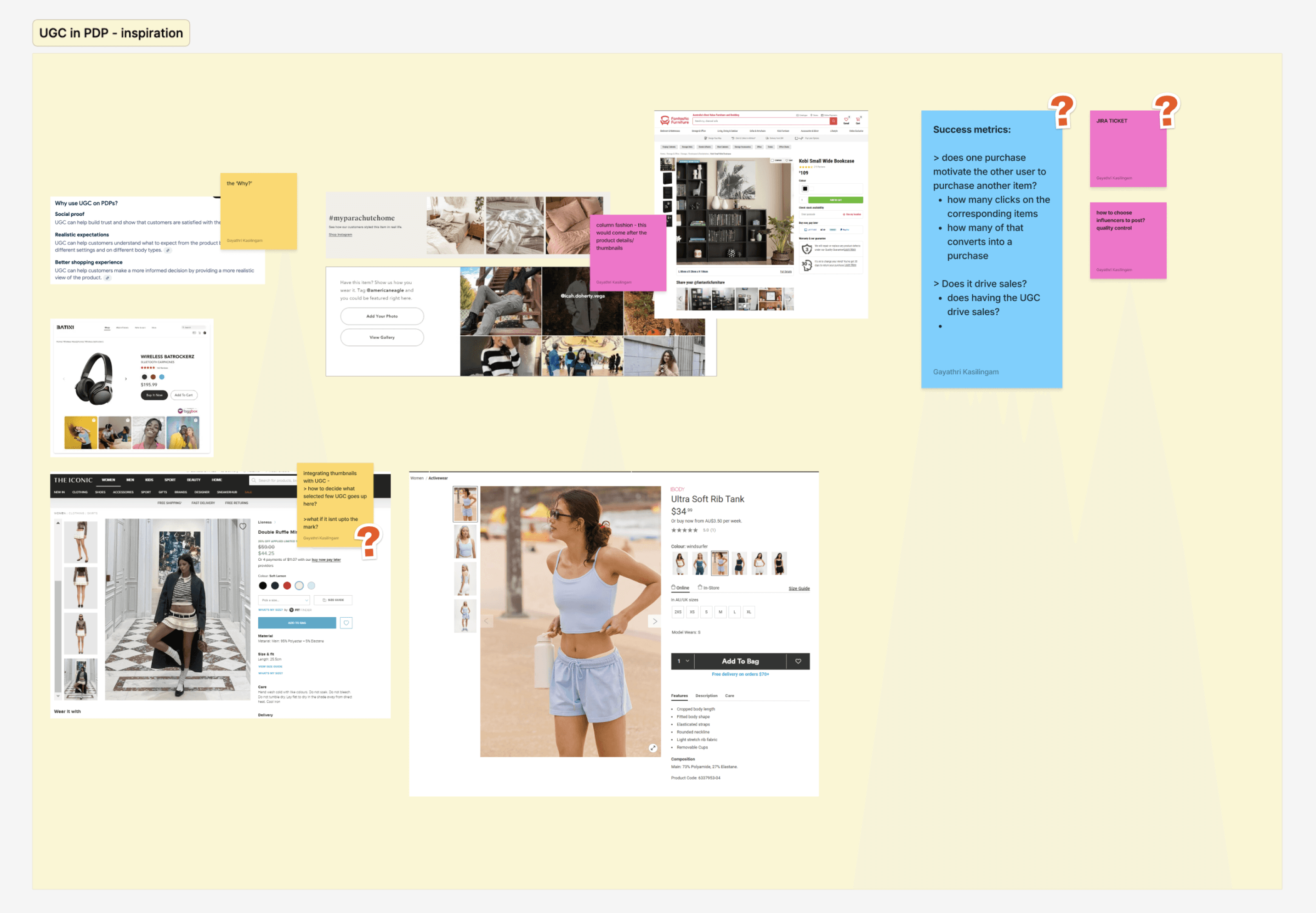
Researched industry best practices & the main 'why' behind doing this.
My Approach: Bypassing roadblocks with resourceful lean design
This situation called for a blend of strategic thinking and design ingenuity. Instead of letting the API constraint derail the project, I leaned into our core values of Lean UX and a "bias for action". My solution involved strategically adapting our approach to integrate static UGC images into the PDPs. This resourceful design choice allowed us to circumvent the immediate technical complexities, proving the concept's value efficiently without extensive upfront investment. It was a clear demonstration of how flexible design and problem-solving can overcome real-world limitations and keep critical initiatives moving forward.
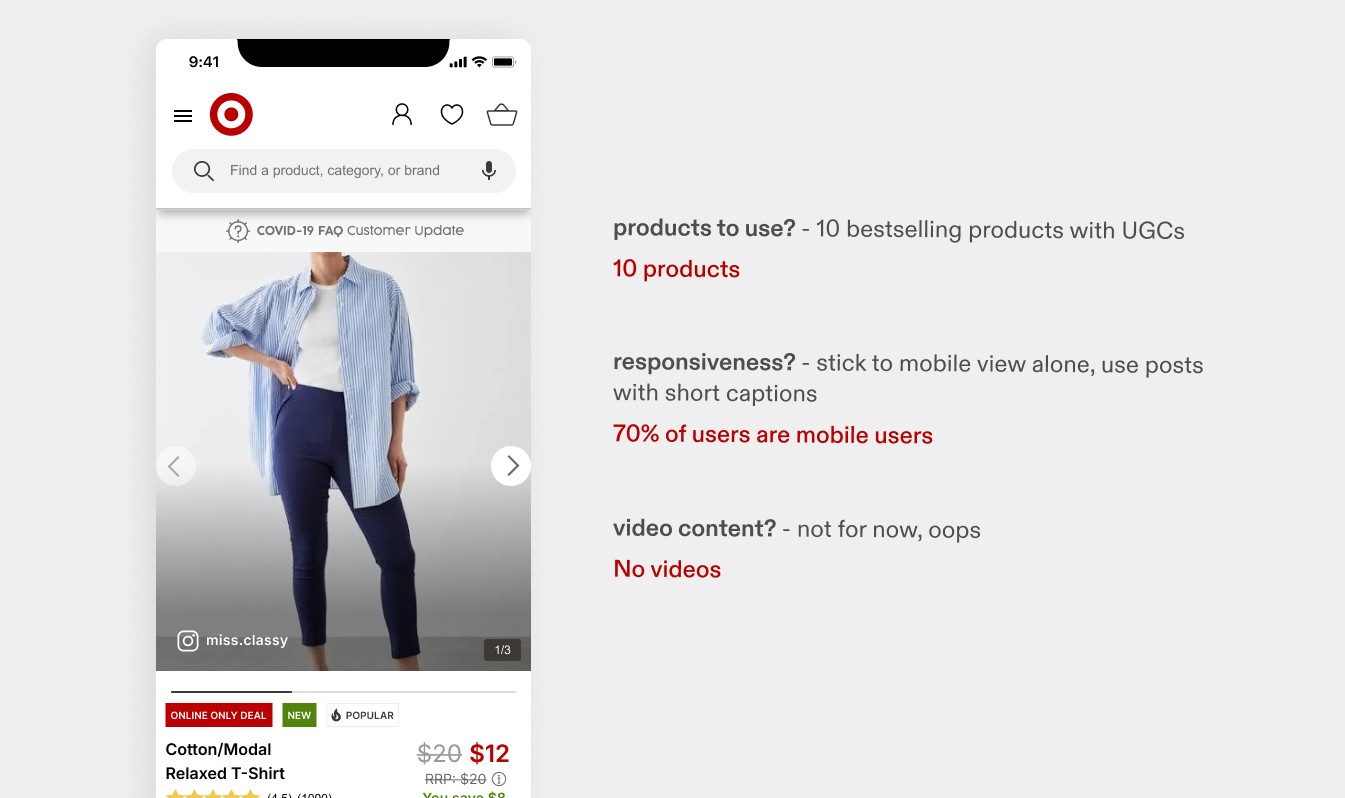
our game plan: use static photos with usernames, just enough to run the experiment
The Results: A 3.2% Leap in Revenue — Validating Our Ingenuity
The impact was undeniable. In just three weeks, our UGC experiment led to a remarkable 3.2% increase in overall revenue. This wasn't just a number; it was a clear signal that prompted our investment decision, greenlighting a full-feature rollout the very next month.
Looking Forward: Scaling for Continuous Growth
visualization of how this would look like in full rolled out version
Building on this success, we've outlined key next steps to further optimize and scale the impact of UGC:
Curating Selected UGCs
Implementing a robust curation process to feature the most impactful and relevant content, further amplifying trust and conversion rates.
Content Creator Recognition
Exploring avenues to recognize and reward content creators, fostering a vibrant community and encouraging more high-quality submissions.
Automatic Video Play Experimentation
Piloting automatic video play for select UGC to capture user attention more effectively and provide richer product context.